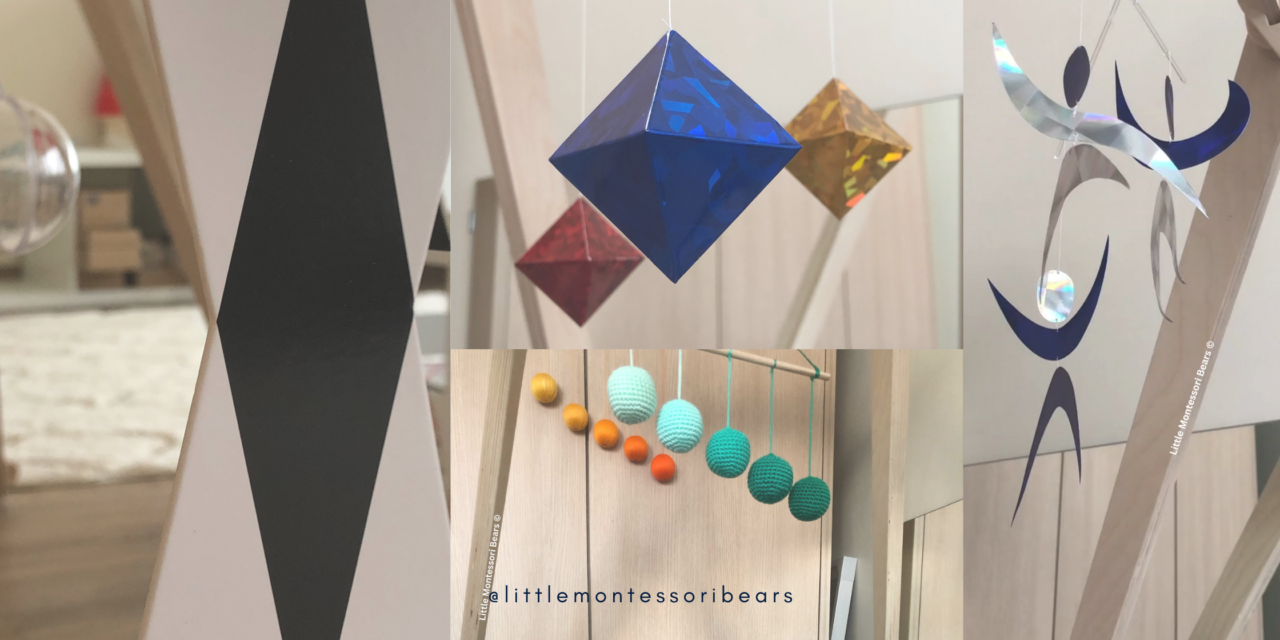
If there’s one thing to know about Montessori material, it’s that everything has been thoughtfully and scientifically designed to capture the child’s attention and engage them. The Montessori mobiles are no exception. Today I will talk to you about four visual Montessori mobiles that are introduced in the first three months of a newborn’s life. All these mobiles are light and move delicately with the natural currents in the room. This allows for baby to be able to focus their attention on the mobile and support their visual perception and concentration without being overstimulating.
While we call these mobiles Montessori, none of these were designed by Dr. Montessori herself, but by educators and designers who were inspired by her principles and observations on the child’s natural development.
All these Montessori mobiles can be made from home with the right templates. If, however, you are less crafty or don’t have the time, you can find ready made ones from small business owners (on Etsy and elsewhere).
The Munari Mobile
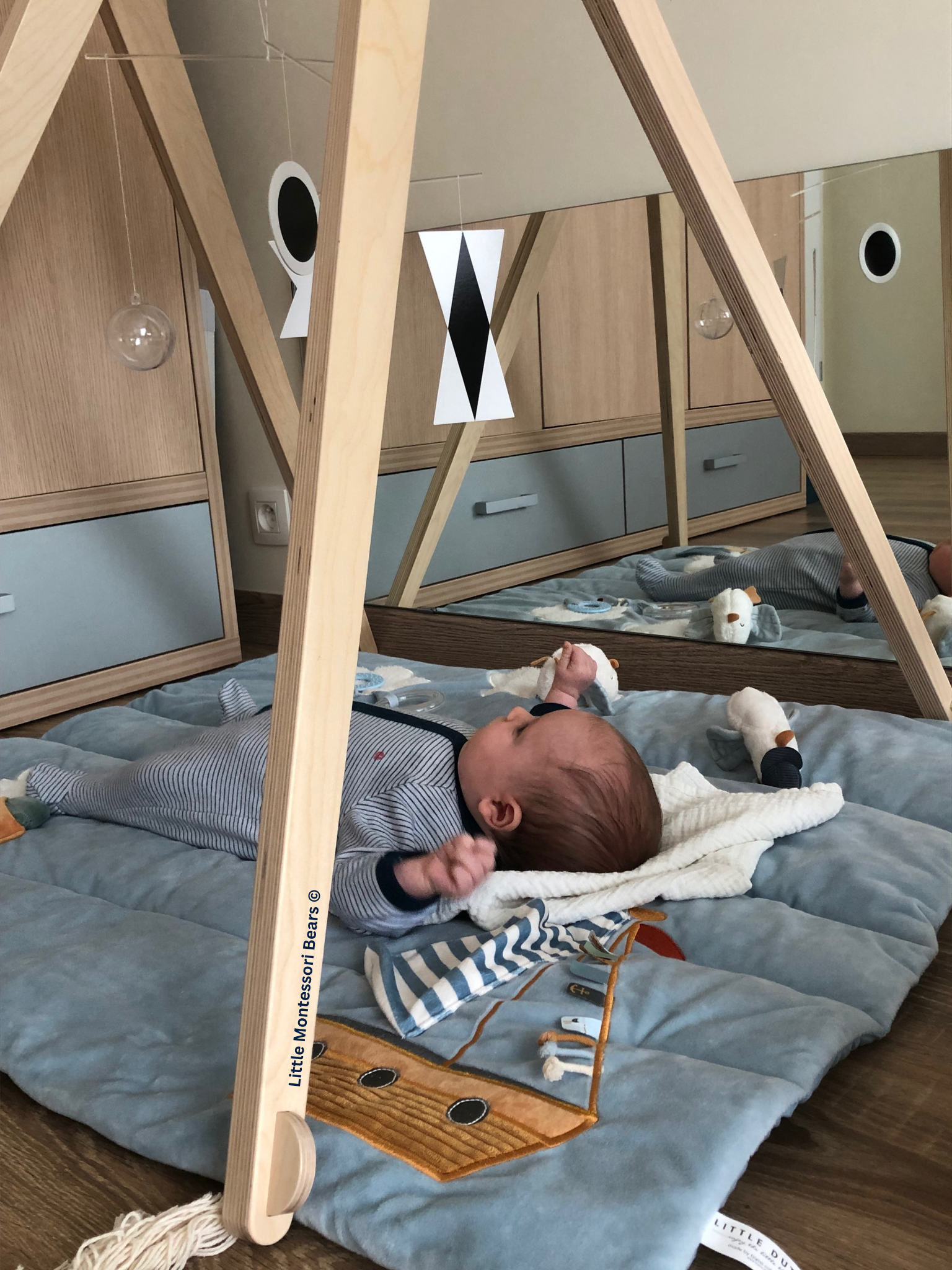
This is the first in the series of four visual Montessori mobiles. It is named after its designer Bruno Munari, an Italian artist. The Munari mobile consists of black and white geometric shapes and a glass sphere the catches and reflects the light (often they are made with a plastic sphere – but the effect isn’t quite the same).
This mobile is particularly adapted as the first mobile for a newborn, as the newborn’s colour perception isn’t fully developed yet. High-contrast black and white images and mobiles hold babies’ attention and help them develop their retina.
This mobile is typically introduced from 2 to 6 weeks, depending on baby’s alertness, until about two months, depending on his interest.
The Octahedron Mobile
The Octahedron Mobile is a mobile that consists of three octahedrons (solid figures having eight faces) in all three primary colours. It is the second mobile to be introduced to a newborn. It is made of shiny paper to catch the light.
It is made of the three primary colours for baby’s developing eyesight. The fact that the figures are 3-dimensional and shaped by equilateral triangles, exposes baby to geometrical concepts.
This mobile is generally introduced from 7 to 12 weeks, depending on baby’s loss of interest in the Munari mobile and his increased interest in his surroundings. At around 7 weeks is when baby is able to distinguish the difference in contrast between the primary colours.

The Gobbi Mobile
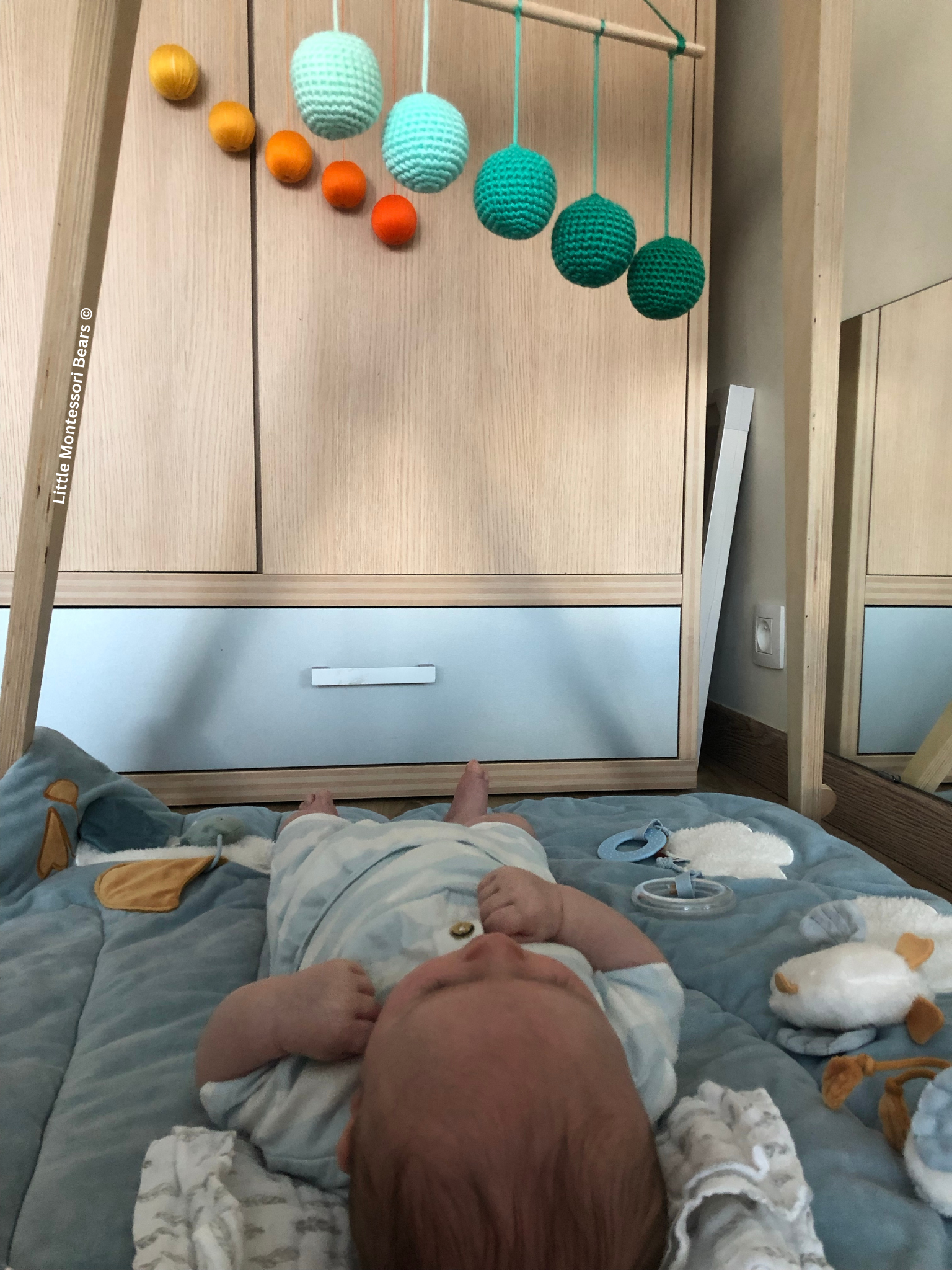
The Gobbi mobile consists of five spheres of a single colour in varying shades. The spheres are hung in ascending order, from darkest to lightest. This is the third mobile of the four to be introduced to baby. It is made of five styrofoam balls around which coloured yarn is wrapped around. It was designed by Gabriella Gobbi in collaboration with Maria Montessori.
This mobile introduces colour gradations that refine the baby’s chromatic sense and visual discrimination as they differentiate between shades of the same colour. In addition to this, the spheres are hung at a 45° degree angle, allowing babies to really see the slight variations in colour but also practice depth perception. This mobile is often used to decorate the room even after baby has moved on to different mobiles and materials or toys.
This mobile is typically introduced at around 12 weeks, sometimes earlier, depending on when baby looses interest in the Octahedron mobile and on his continuous growing interest in his environment. Around this time, baby is able to see the full colour spectrum.
I have two Gobbi mobiles. I had bought one from Les Petites Mains Montessori, and received another one as part of a set that contains all four mobiles.
The Stylized Dancers Mobile
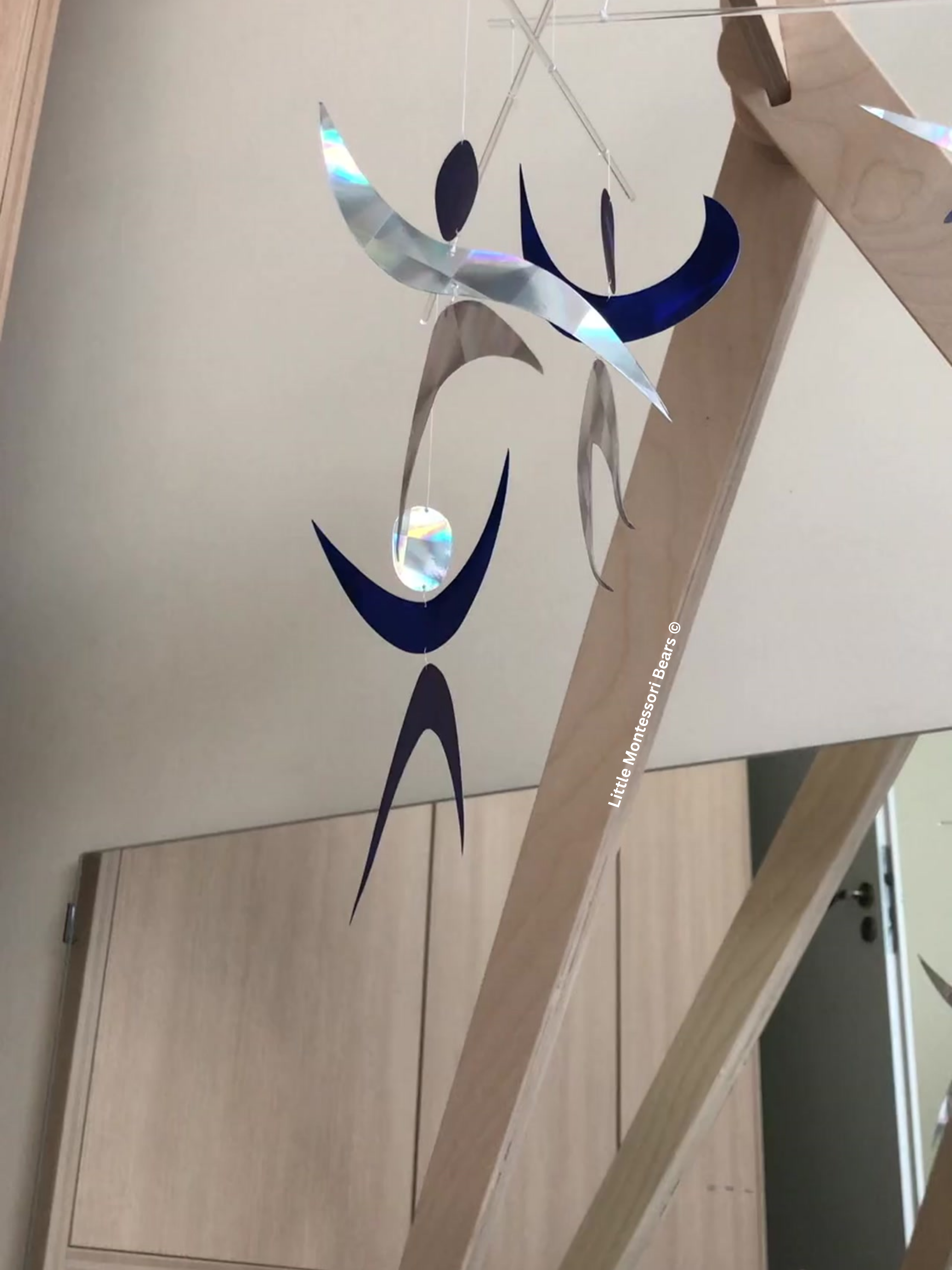
The Dancers mobile is made up of four stylised forms representing human figures. When they move, they look like dancers. It is the fourth mobile in the series to be introduced to baby. Each figure is made up of three parts that move independently: head, arms and legs. They’re made of holographic paper. It’s the colour contrast, the reflection of the light and the delicate movements that catches baby’s attention. It encourages depth perception, visual tracking and visual focus.
This mobile is typically introduced from 14 weeks, depending on his loss of interest in the Gobbi mobile and his improving hand-eye coordination and interest in grabbing things. This mobile introduces the concept of “constant and change”. This is the concept that even when things move their colour and shape remain the same.
More Montessori Mobiles
While the above are the traditional four Montessori mobiles that help baby develop their eyesight, there are other mobiles that you can introduce to your little one in order to continue refining these skills. Some will introduce a rainbow mobile, while others may introduce the Montessori animal mobiles. They are beautiful and I will dedicate a future post to these soon! 😉
There will come a stage – probably when baby has outgrown these visual mobiles, and his hand-eye coordination has continued to develop – when your baby can be introduced to tactile mobiles.
Where to Find Them
As mentioned above, you can find ready-made ones through a variety of small business owners. You can also find many templates and guides online to make your own. Below, I’ve listed the DIY guides for the four visual mobiles from “The Parent’s Guide to Montessori”:
- The Munari Mobile (PDF Download)
- The Octahedron Mobile (PDF Download)
- The Gobbi Mobile (PDF Download)
- The Stylised Dancers Mobile (PDF Download)
Have you introduced any of these mobiles to your little one? Are you planning to? Let me know how it went, what you’ve observed and which one has held your little one’s attention the most!